
28/10/2026
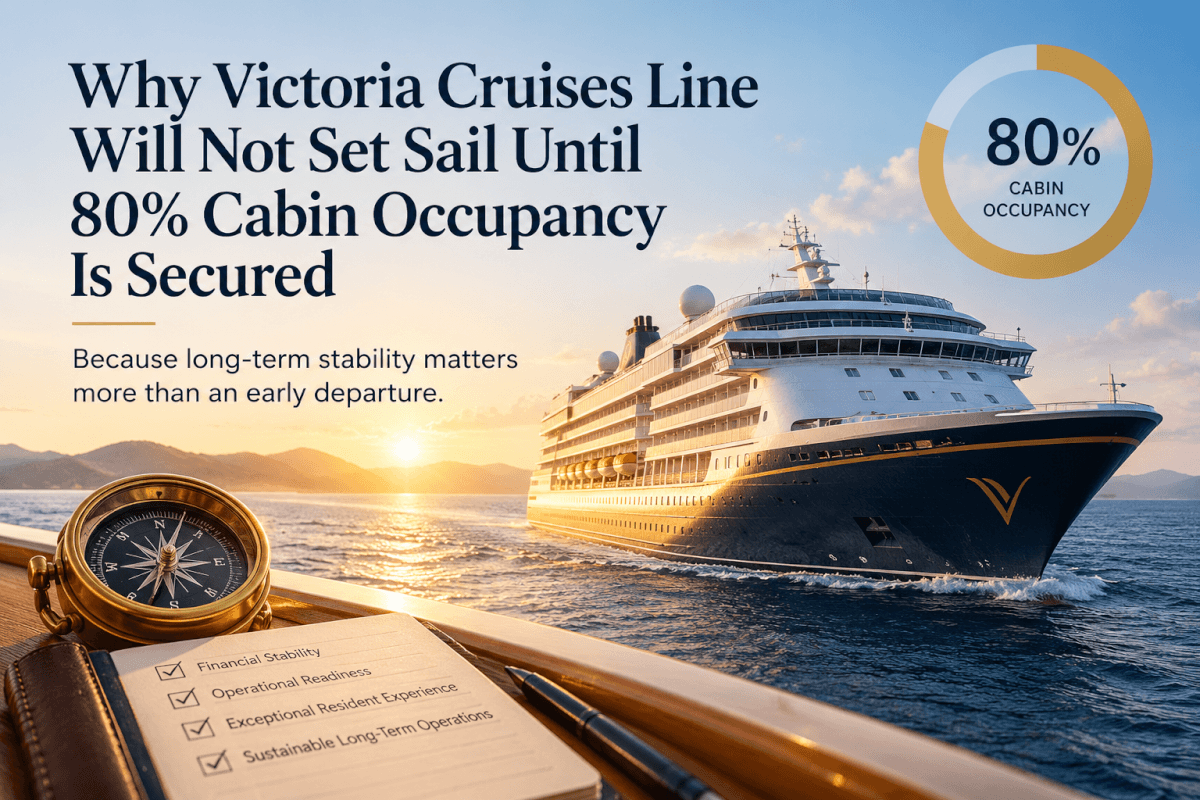
Long-term stability matters more than a premature departure
Residential cruising offers an extraordinary way of life. Unlike traditional cruise passengers, residents are not simply boarding for a short vacation. They are choosing to make a ship their home for months or even years.
This requires a fundamentally different approach to financial planning and ship operations.
At Victoria Cruises Line, we have established a clear principle: we will not commence operations until at least 80% of our cabin capacity has been secured through qualifying bookings.
Why 80% occupancy?
Operating an ocean-going vessel involves substantial fixed costs, regardless of how many residents are on board.
These include fuel and energy, crew salaries, maintenance, technical operations, port fees, insurance, catering, and essential onboard services.
Many of these expenses cannot be reduced proportionally when fewer cabins are occupied.
Our 80% occupancy requirement is designed to provide a more predictable revenue foundation before operations begin, rather than relying on uncertain future bookings to support the ship's ongoing expenses.
Setting sail is not the same as achieving long-term success
In recent years, the residential cruising industry has seen projects encounter significant operational and financial difficulties.
These developments offer important lessons for the entire sector.
Launching a ship is an achievement, but it is not proof that the operation can remain financially sustainable over time.
The real challenge is maintaining reliable operations month after month and year after year, while delivering the services and itineraries promised to residents.
For Victoria Cruises Line, the question is not simply how quickly we can depart. It is whether we can begin operations under conditions that support long-term continuity.
We do not want residents to carry the consequences of inadequate planning
Choosing to live aboard a residential ship is a major life decision.
Residents may leave behind their homes, familiar surroundings, and established routines to embrace an entirely new lifestyle.
Such a commitment deserves responsible planning.
Victoria Cruises Line does not want to create a situation in which insufficient initial occupancy leads to extraordinary financial requests from residents to cover ordinary operating expenses.
Our minimum occupancy requirement is intended to reduce that risk.
Why not depart with fewer residents?
We understand that many future residents are eager to begin their new lives at sea.
We also recognize the frustration that comes with waiting.
However, departing with insufficient occupancy could expose the operation to significant financial pressure over time.
We would rather accept the inconvenience of a later departure than make a premature decision that could jeopardize the future of the residential community.
Reaching 80% occupancy is not, by itself, a guarantee of financial stability. All necessary technical, financial, staffing, regulatory, and operational requirements must also be satisfied before departure.
Trust is a long-term commitment
Victoria Cruises Line is not simply planning another voyage around the world.
Our vision is to create an international residential community where people can enjoy the freedom of life at sea, discover new cultures, and experience the comfort of a home that travels with them.
Achieving that vision requires responsible decisions long before the first departure.
That is why we are committed to waiting until at least 80% cabin occupancy is secured. Not because we do not want to set sail, but because our goal is not merely to begin the journey. Our goal is to build an operation designed to last.
Author: Victoria Cruises team
28/10/2026
